
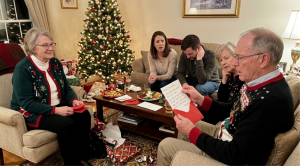
I never thought I would have to pay forty-five dollars to eat Thanksgiving dinner with my own family.
Not after everything I had done for them.
Not after all those years of helping without asking anyone to notice.
But that was exactly what happened.
And the worst part was that my daughter-in-law, Brittany, seemed to think there was nothing unusual about it.
My name is Georgia.
I spent thirty-one years working behind the deli counter at Kroger.
Thirty-one years of early mornings, aching feet, and standing on floors that felt harder every winter.
I learned to smile even when my knees hurt.
I learned to stretch a paycheck.
And I learned that sometimes loving your family meant doing things nobody would ever thank you for.
My husband, Hal, understood that.
He worked overtime whenever our household needed extra money.
There were years when we put off buying things for ourselves because something needed fixing or our son needed something.
We never called it sacrifice.
We called it being parents.
Our son, Kyle, grew up in a house where we tried to make every dollar count.
I was proud of the man he became.
At least, I thought I knew the man he had become.
He married Brittany, and they had two beautiful children.
One was our little Emma.
The other was her brother.
Those grandchildren brought a kind of happiness into my life that I had not expected to feel so strongly again after losing Hal.
When I heard their voices, my house felt less empty.
When Emma asked me to bake something, I usually found myself reaching for the flour before she finished speaking.
That was the kind of grandmother I wanted to be.
Someone they could count on.
Someone whose love did not come with conditions.
I suppose that was also how I had tried to be a mother.
Maybe too much.
I had been helping Kyle with expenses for years.
It started when he needed a little room in his budget.
A phone bill here.
Truck insurance there.
Nothing that seemed worth making a fuss over.
I had my pension.
I received Social Security.
Hal and I had managed to pay off our house.
We had savings, too.
I was not wealthy.
But I was comfortable enough to help.
And Kyle was my only son.
I never imagined those quiet payments would become the center of a family argument.
I certainly never thought they would have anything to do with Thanksgiving dinner.
That holiday had always mattered to me.
It was one of those days when I could almost hear Hal moving around the kitchen.
He loved having everybody together.
He liked the ordinary sounds.
Dishes touching the counter.
Children calling from another room.
Somebody asking when the food would be ready.
After he died, I held on to those gatherings.
I needed them more than I admitted.
So when Kyle and Brittany hosted Thanksgiving, I was happy to come.
I brought the dishes they knew I would bring.
My noodles were always expected.
And I had spent time making food for the table because I wanted to contribute.
I had never considered showing up without something in my hands.
That was simply how I was raised.
You brought what you could.
You helped where you could.
And when everyone sat down, you were family.
No one kept score.
Or so I believed.
That Thanksgiving, something felt different.
I noticed the small cards Brittany had prepared.
There were amounts written down.
Little calculations that made the meal look less like a family gathering and more like an expense someone was trying to divide.
At first, I told myself I was misunderstanding.
Brittany liked to organize things.
She had strong opinions about money and how expenses should be handled.
I knew that much.
But I never expected to see my own place at the table treated like a bill.
Then she made it clear.
My portion of Thanksgiving dinner would cost forty-five dollars.
I looked at her.
For a moment, I honestly thought she was joking.
I had brought food.
I had helped prepare part of the meal.
And I was sitting in my son’s home, surrounded by people I loved.
I waited for somebody to laugh.
Nobody did.
Brittany seemed perfectly serious.
I looked toward Kyle.
He was right there.
My son.
The little boy I had once carried into the grocery store while Hal worked long hours.
The boy whose school pictures I still kept.
The grown man whose expenses I had been helping cover for years.
I expected him to say something.
Anything.
Even a quiet word to his wife would have been enough.
But Kyle said nothing.
That silence was what I remembered most clearly afterward.
Not Brittany’s expression.
Not the amount.
His silence.
I could have argued.
I could have reminded them about every dollar I had spent helping their household.
I could have pointed out that the food I brought had cost money too.
But I did none of those things.
I sat there trying to understand how a holiday I had looked forward to could suddenly make me feel like an outsider.
Forty-five dollars.
It was not an amount that would ruin me.
I had spent more than that helping other people without thinking twice.
That was why the request hurt.
The money was small compared with everything I had already given.
Yet somebody had decided my presence came with a charge.
I paid.
I wish I could tell you I stood up for myself immediately.
I didn’t.
I paid because I did not want a disagreement at the Thanksgiving table.
I paid because my grandchildren were there.
And I paid because part of me still believed Kyle would speak to me afterward and explain.
I thought he might apologize.
I thought he might tell Brittany she had gone too far.
I waited.
The meal continued.
People ate.
Conversations went on around me.
I remember looking at the food I had helped provide.
I remember wondering whether anyone had calculated its cost.
Then I felt ashamed of myself for even thinking that way.
I had never wanted to count what I gave.
That was the whole point.
When I brought food, I brought it because I loved them.
When I paid a bill, I paid it because I wanted to make their lives easier.
I did not want every family favor turned into a transaction.
Yet there I was, mentally adding things up.
I hated the feeling.
By the time the gathering ended, I was tired in a way that had nothing to do with cooking.
I went home thinking about Hal.
I wondered what he would have said.
He was a practical man.
He understood the importance of money, but he never confused money with respect.
During our forty-two years together, he had taught me that helping people was good.
Allowing them to take your help for granted was something else.
I had understood those words when he was alive.
I had simply stopped applying them to Kyle.
That evening, I sat at my kitchen table.
It was the same table where I had sorted household bills for years.
I had worked out grocery budgets there.
I had figured out what we could save.
I had sat across from Hal when we discussed expenses we could not avoid.
Now I sat alone.
The house was quiet.
And I kept returning to the same question.
Why had forty-five dollars upset me so much?
It was not because I could not afford it.
It was not because I wanted special treatment.
I had never expected Brittany to serve me dinner like some honored guest.
All I wanted was to be treated as a member of the family.
Someone whose contribution was understood, even when nobody mentioned it.
Instead, I had been handed a price.
I looked toward the drawer where I kept my financial papers.
I knew what was inside.
Records of payments.
Insurance information.
Phone bills.
The ordinary documents that told the story of where my money went.
Most people would have found them boring.
But I knew what they represented.
Years of helping Kyle.
Years of making sure he did not have one more thing to worry about.
And not just Kyle.
That was the part nobody had mentioned at Thanksgiving.
Several members of Brittany’s family had been benefiting from an arrangement I continued paying for.
I had never complained.
I had never expected a public thank-you.
But I was beginning to wonder whether they even knew.
I opened the drawer.
The papers were where I had left them.
I took out the phone account information.
Then I found the insurance paperwork.
I spread the documents across the table.
At first, I was only looking.
I did not have a plan.
I wanted to see what I had been paying and how long I had been paying it.
Sometimes the mind gets used to a monthly expense.
It becomes part of the household budget.
You stop asking why it is there.
You simply pay it.
That was what I had done.
Month after month.
Year after year.
I studied the phone account.
Seven lines were connected to the family plan.
Seven.
I had known the number, of course.
I was the one paying.
But seeing those lines printed together made me stop.
Each number belonged to a person.
Each person had been enjoying service that someone else was quietly covering.
Some of them probably thought their bills were being handled by Kyle.
Others may not have thought about the bill at all.
And for years, I had allowed that.
I had told myself generosity was supposed to be quiet.
I still believed that.
But I was starting to see that quiet generosity could create a strange kind of confusion.
People stopped recognizing help.
They began to expect it.
I looked at Kyle’s information.
Then I looked at the insurance policy covering his truck.
That payment had once made sense.
He had needed some breathing room financially.
I had wanted to give it to him.
But the temporary arrangement had become permanent.
No one had ever come back and asked whether I still wanted to carry it.
I had not asked either.
That was my part in the problem.
I had kept giving without discussing when the help should end.
And Kyle had kept accepting without asking whether it was fair.
I sat with that thought for a long time.
There was no pleasure in it.
I did not feel clever.
I did not feel powerful.
I felt foolish.
Not because I had helped my family.
I would never regret helping someone I loved.
I felt foolish because I had confused being needed with being appreciated.
Those were not the same thing.
By the time I began putting the papers away, the kitchen seemed colder.
I folded the insurance document.
Then I stopped.
There was no reason Kyle could not pay his own truck insurance.
There was no reason healthy adults could not arrange their own phone plans.
And there was certainly no reason I should have to apologize for deciding how to spend my retirement money.
I had worked for it.
Hal had worked for our family’s security too.
We had saved carefully.
We had made choices.
That money was meant to support my life as I grew older.
I wanted to enjoy my grandchildren.
I wanted to keep my home comfortable.
I wanted to spend my remaining years without worrying that every dollar I saved already belonged to somebody else.
I thought about the forty-five dollars again.
I wished I could forget the whole thing.
But every time I tried, I saw Kyle sitting there, saying nothing.
I had raised him to be kind.
I had raised him to notice when somebody was being treated unfairly.
And on Thanksgiving, he had watched his wife put a price on his mother’s dinner.
That hurt more than any bill.
I put the papers back on the table.
I was not ready to decide everything that night.
But I knew one thing.
Christmas would not be another holiday where I swallowed my feelings and pretended nothing had happened.
I wanted my family to understand what had been happening quietly for years.
Not because I wanted applause.
Because I wanted the truth to be understood.
I had given them help.
I had never promised to give it forever.
And before I turned off the kitchen light, I made myself one quiet promise.
I would not spend the rest of my life paying for the privilege of being treated like family.

