
CLICK HERE FOR MORE
I used to believe that a mother should never make her child ask permission to come home.
Even when that child was grown.
Even when he had his own wife, children, and house.
That belief had stayed with me for most of my life.
Then I turned sixty-eight.
And the morning after my birthday, I sat on my front porch while my son stood on the other side of a locked door.
He had a key.
He simply couldn’t use it anymore.
I heard the metal scrape inside the new lock.
Once.
Then again.
The third time, he twisted the key so hard that I thought it might break.
I kept my eyes on the paperback resting in my lap.
I wasn’t reading much.
I had been staring at the same paragraph for several minutes.
But I wanted him to understand that I wasn’t going to jump up just because he had arrived.
“Mom?”
I turned a page.
“Mom, I can see you.”
“I know, Jeffrey.”
He looked through the glass of the storm door.
His eyebrows pulled together.
“Something’s wrong with my key.”
“There’s nothing wrong with your key.”
He tried it again.
I watched his hand move.
That little key had been on his ring for years.
I had given it to him because I wanted him to know he was always welcome.
At the time, it had seemed like a loving thing to do.
Now I understood that being welcome and having unlimited access were not the same thing.
“Did you change the lock?”
“I did.”
He stared at me.
“You changed your locks without telling me?”
I closed the book around my finger.
“Yes.”
“But why?”
“Because I want people to knock before coming into my home.”
He looked genuinely confused.
That bothered me more than his anger would have.
It meant he had never considered that I might want privacy.
His wife, Monica, came up the front walk behind him.
She was holding her sunglasses in one hand.
Her handbag hung from her other arm.
I recognized the diamond bracelet around her wrist.
I had seen it before.
I had also spent enough years helping Jeffrey and Monica with their expenses to recognize how uncomfortable that bracelet made the situation.
Monica looked from Jeffrey to the door.
“What’s going on?”
“She changed the locks.”
Monica stared through the glass.
“You’re kidding.”
“No.”
“Why would you do something like that?”
I placed my paperback on the small table beside my chair.
“Because this is my house.”
Jeffrey pressed his palm against the frame.
“Can you open the door? We need to have a conversation.”
“We can have one right here.”
He looked back at Monica.
I could see the embarrassment beginning to settle across his face.
“Mom, please.”
I looked at him for a long moment.
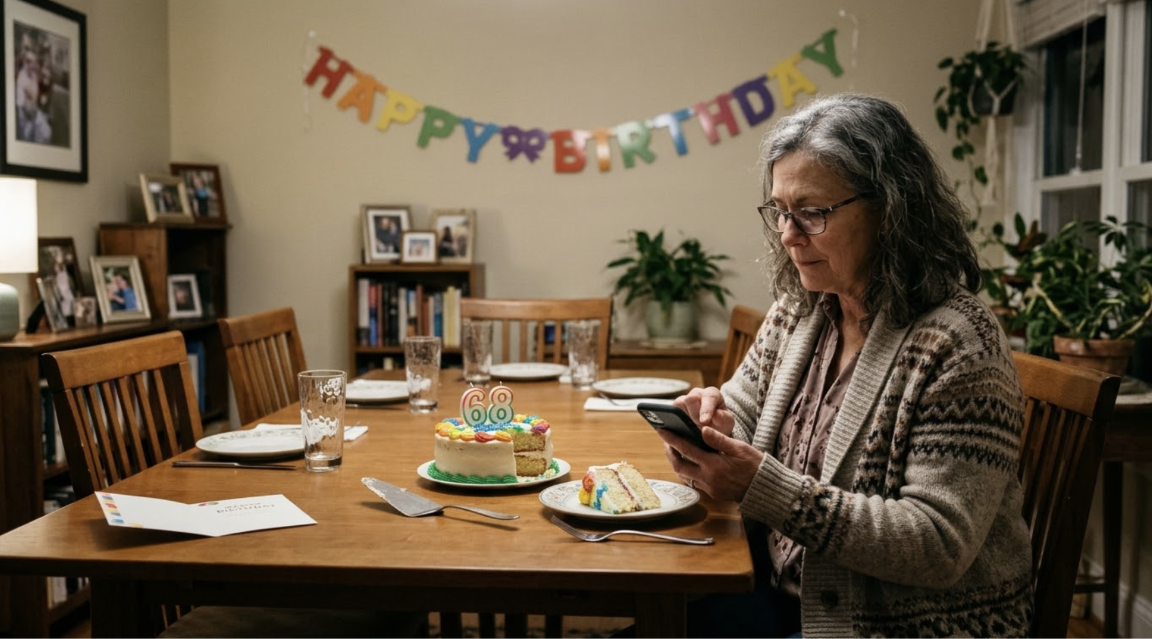
The night before, I had prepared a birthday dinner for five people.
Five plates.
Five places at the table.
I had been looking forward to having Jeffrey, Monica, Oliver, and Stella with me.
Instead, my son had called to say they wouldn’t be coming.
Monica wasn’t feeling well.
She had a migraine.
That was what he told me.
I had accepted it.
I had even worried about her.
Then I learned where they actually were.
Bellini’s.
A restaurant.
And they were using my credit card.
The same card I had given them for emergencies.
I looked at my son standing outside my own front door.
“Yesterday you couldn’t come here for my birthday because Monica was sick. Today you’re both standing here demanding to be let inside.”
He shifted his feet.
“Mom, that wasn’t what happened.”
“Then perhaps you can explain it.”
Monica folded her arms.
“You’re making an enormous problem out of dinner.”
I looked at her.
“Am I?”
“Yes. We missed one family dinner.”
One dinner.
That was what it had become.
I remembered all the Sundays I had cooked for them.
All the afternoons I had picked up the children.
All the times Jeffrey had called because some bill had arrived at the wrong moment.
I had always made room.
Always found a way.
Always convinced myself that families were supposed to help each other.
But I had begun to wonder when help had turned into expectation.
Jeffrey rubbed the side of his forehead.
“Can we please talk about the card instead of arguing about my missing your birthday?”
I almost laughed.
He had said the quiet part without meaning to.
The card mattered.
My birthday didn’t.
“How much was dinner last night?”
He blinked.
“What?”
“Your dinner at Bellini’s. How much did it cost?”
Monica looked toward him.
“Why are we discussing that?”
“Because I would like to know.”
Jeffrey sighed.
“I don’t remember the exact amount.”
“Was it more than a hundred dollars?”
“Mom.”
“More than two hundred?”
He looked annoyed.
“That’s beside the point.”
I nodded slowly.
“That’s interesting. I thought it was very much the point.”
Monica stepped closer.
“We have two children. We don’t get much time alone. Sometimes we need to go out together.”
I looked at her.
“I understand wanting time with your husband.”
“Then why are you behaving this way?”
“Because wanting an evening out doesn’t make it an emergency.”
She pressed her lips together.
I continued before she could answer.
“I gave you that card for situations when you genuinely needed help.”
Jeffrey raised one hand.
“All right. We shouldn’t have charged dinner to it.”
It was the closest thing to an admission I had heard.
But it didn’t last.
“You could have called me before shutting it down.”
I stared at him.
“Jeffrey, you called me from the restaurant because the payment wouldn’t go through.”
He looked away.
I had not forgotten that call.
I remembered the irritation in his voice.
Not worry.
Not embarrassment.
Irritation.
He wanted the card restored.
He wanted the inconvenience gone.
And for a moment, I had almost done it.
That was what frightened me afterward.
How easily I had nearly given in.
Monica turned toward the driveway.
“Jeff, just explain why we’re here.”
I looked from her to my son.
Until then, I had assumed they had come because of the frozen card.
But something about Monica’s voice made me sit straighter.
“What else do you need?”
Jeffrey didn’t answer immediately.
He put both hands into his pockets.
Then he looked at me.
“We need access to the money.”
I waited.
“What money?”
“The money market account.”
There it was.
The real reason they had come.
Not to ask whether I had enjoyed my birthday.
Not to explain what had happened the previous evening.
Not even to say they were sorry.
They wanted money.
I felt a strange heaviness settle in my stomach.
“That account is no longer available to you.”
Jeffrey stared.
“What do you mean?”
“I moved my money.”
He stepped toward the door.
“You moved it where?”
“Into an account that belongs only to me.”
His expression changed.
“All of it?”
“The money that belonged to me, yes.”
He looked at Monica.
She removed her sunglasses completely.
“You can’t be serious.”
“I am.”
Jeffrey shook his head.
“Mom, we’ve been using that account.”
“I know.”
“We have expenses connected to it.”
“I know that too.”
“Then why would you suddenly move everything?”
I looked down at my hands.
They were resting quietly on the arms of my chair.
I had spent years feeling nervous whenever Jeffrey called about finances.
Now he was the nervous one.
And that made me realize how much responsibility I had carried without noticing.
“The money came from your father’s life insurance and the sale of his boat.”
Jeffrey’s face tightened when I mentioned Bruce.
My husband had been gone for three years.
Even now, speaking about him could make a room feel different.
Bruce had worked hard.
He had been careful with money.
And when he died, I had tried to preserve the life we had built together.
But somewhere along the way, the money he left for my security had become something Jeffrey and Monica expected to use.
Monica shook her head.
“That wasn’t how you described the account when we opened it.”
I looked directly at her.
“I remember exactly what I said.”
She said nothing.
“I said I wanted money available for serious family emergencies.”
Jeffrey shifted his weight.
“I know.”
“A medical bill that couldn’t wait. A necessary repair to your house. Something important that had to be handled quickly.”
Monica stared at the glass.
“I never promised to finance your ordinary spending.”
Jeffrey let out a breath.
“Mom, you’re changing everything at once.”
“Yes.”
“That’s not fair.”
I had expected those words.
For years, fairness had meant finding a way to make things easier for Jeffrey.
I had rarely asked whether the arrangement was fair to me.
“We’ll have to arrange our bills differently,” he said.
“Then that’s what you’ll need to do.”
He looked genuinely offended.
“You can’t just leave us to figure this out.”
I felt my fingers tighten around the chair.
That sentence stayed with me.
He was a grown man.
A husband.
A father.
And he was telling his sixty-eight-year-old mother that he couldn’t be expected to manage his own bills.
“I can decide how my money is used, Jeffrey.”
Monica moved closer to the door.
“You’re doing this because we didn’t attend your birthday dinner.”
I looked at her handbag.
Then at the bracelet on her wrist.
Then back at her face.
“No. Your absence made me look at something I should have examined years ago.”
“What does that mean?”
“It means helping you has become something you expect instead of something you appreciate.”
Jeffrey shook his head.
“That isn’t fair.”
“Perhaps it doesn’t feel fair to you.”
Monica made a sharp sound.
“You’re talking as though we’re taking advantage of you.”
I studied her for a moment.
I could have said a great deal.
I could have mentioned the purchases I had already noticed.
I could have asked why they could afford restaurant dinners and expensive shopping but still needed help paying ordinary expenses.
Instead, I kept my voice calm.
“I’m saying I won’t continue paying for choices you make without involving me.”
For several seconds, nobody spoke.
A car passed on the street.
I could hear a bird calling from the neighbor’s tree.
Everything around us seemed perfectly ordinary.
That made the conversation feel even stranger.
Then Jeffrey looked at me with an expression I had rarely seen.
“Do you have any idea how humiliating this is?”
I leaned back.
“Humiliating?”
“Yes. Being locked out of my mother’s house. Having a card declined in public. Finding out you moved money without telling us.”
I listened.
He had listed every inconvenience he had suffered.
Not one word about mine.
Not one question about the birthday dinner.
I felt my throat tighten.
“Jeffrey, do you know what it felt like to sit at a table prepared for five people and eat alone on my sixty-eighth birthday?”
He lowered his eyes.
I waited.
For once, I didn’t rush to fill the silence.
I didn’t tell him it was all right.
I didn’t make an excuse for Monica.
I didn’t offer to restore the card.
He had nothing to say.
And I discovered that silence could be more useful than another argument.
I picked up my book again.
My son remained outside the door.
The key was still in his hand.
But neither of us mentioned the lock.
I had spent years making it easy for Jeffrey to enter my house, my schedule, and my savings whenever he wanted.
That morning, I finally understood that I could love him without leaving every door open.

