
I used to think the worst thing my brother could do was keep me from saying goodbye to our father.
I was wrong.
By the time I learned the truth, Dad had already been cremated.
His belongings had been packed away.
His house was sitting empty.
And my brother, Ray, had assured me there was nothing left to discuss.
No unfinished business.
No important paperwork.
No will.
I had believed him.
That was the part I struggled to admit afterward.
I had trusted Ray because he was my brother.
Because he lived close to Dad.
Because for years, he had been the person who answered whenever something went wrong.
I lived six hours away.
Ray never let me forget that.
Whenever Dad needed groceries, Ray went to the store.
Whenever he had a medical appointment, Ray drove him.
Whenever something broke around the house, Ray was usually the first person to hear about it.
I had been grateful for those things.
I had told him so many times.
I had sent money when he said Dad needed help.
Sometimes it was five hundred dollars.
Sometimes it was enough to cover a prescription or another expense Ray mentioned.
I never asked him to produce receipts.
He was my brother.
Looking back, I realized how much I had allowed those four words to excuse.
Dad’s name was William Morrow.
He was eighty-one years old when he died.
He had never been an easy man to read.
He could spend an afternoon repairing something for me without expecting payment, then become uncomfortable if I tried to hug him afterward.
When I was younger, he had driven through terrible winter weather to watch me perform in school plays.
He never complained.
He would sit quietly through the performance and wait until the auditorium emptied before telling me I had done well.
That was Dad.
He showed up.
He fixed things.
He remembered little details.
But he rarely talked about feelings.
After Mom died seventeen years earlier, he became even quieter.
He stayed in the same little white house where Ray and I had grown up.
The shutters were blue.
Mom had planted roses beside the walkway.
There was an oak tree outside, and Dad always complained about the leaves without ever seriously considering cutting it down.
The kitchen still held her things.
The same cabinets.
The familiar smell of cedar and lemon cleaner.
Even the doorframe where Mom had measured our heights when we were children remained untouched.
Dad could have moved somewhere smaller.
He refused.
I assumed he stayed because he couldn’t bear to leave the memories behind.
I had no reason to question that explanation.
There were plenty of things about my father I didn’t know.
His money was one of them.
He drove an old pickup truck.
He watched household expenses carefully.
He wore clothes until they became too worn to repair.
If his electricity bill increased, he noticed.
If I offered to buy him something expensive, he told me to save my money.
Nothing about him suggested he was hiding anything.
Certainly not an estate that would eventually turn my family upside down.
I had always thought Ray understood Dad better than I did.
He lived nearby.
He saw Dad during ordinary weekdays.
I called every Sunday.
Those calls were important to me.
We talked about the garden.
His health.
The weather.
Whatever needed fixing around the house.
Sometimes he asked about my life.
Sometimes he spent ten minutes explaining why his pickup needed another repair.
I listened.
I tried to make up for the distance by being available whenever he wanted to talk.
But distance had a way of making me feel guilty even when nobody said anything.
Ray knew that.
And when Dad died, he used it.
I was still trying to understand the news when Ray began talking about arrangements.
Everything seemed to be moving faster than I could follow.
He told me not to hurry.
He said the important decisions had already been handled.
I was driving from six hours away.
I believed there would be time.
There wasn’t.
By the time I arrived, Dad had been cremated.
I never saw his face again.
I never held his hand.
I never stood beside him for one last moment.
Ray had made sure everything was completed before I reached town.
When I confronted him, he said he had only followed Dad’s wishes.
I wanted to believe that.
I needed to believe it.
Otherwise, I would have had to accept that my own brother had deliberately taken something from me that could never be returned.
I asked about burial arrangements.
Ray gave me answers that felt strangely final.
The cremation was finished.
The decisions were made.
There was nothing to change.
He eventually gave me half of Dad’s ashes.
I remember looking at what he handed me and wondering how an entire lifetime could suddenly fit into something so small.
That was all I had left of the man who had raised me.
Or so I thought.
Later, I asked Ray about Dad’s estate.
Not because I was expecting money.
I wanted to understand what would happen to the house.
I knew Dad had kept documents.
He was particular about paperwork.
He kept receipts long after anyone else would have thrown them away.
He saved birthday cards.
He had files for things most people never bothered to organize.
I couldn’t imagine him dying without leaving instructions.
But Ray dismissed the question.
He told me there was no will.
He said Dad had never bothered to prepare one.
I asked whether he was certain.
Ray insisted he was.
He sounded annoyed that I had even questioned him.
So I stopped.
I told myself that grief was making me suspicious.
I told myself Ray had been dealing with more responsibility than I understood.
I told myself I shouldn’t make things harder.
Those excuses stayed with me until the crematorium contacted me.
Nine days had passed.
Nine days since the sealed envelope had been discovered among Dad’s belongings.
Nine days when I had believed there was nothing else to find.
I went to the cremation center expecting paperwork.
Perhaps a personal item someone had forgotten to return.
I didn’t know what was waiting there.
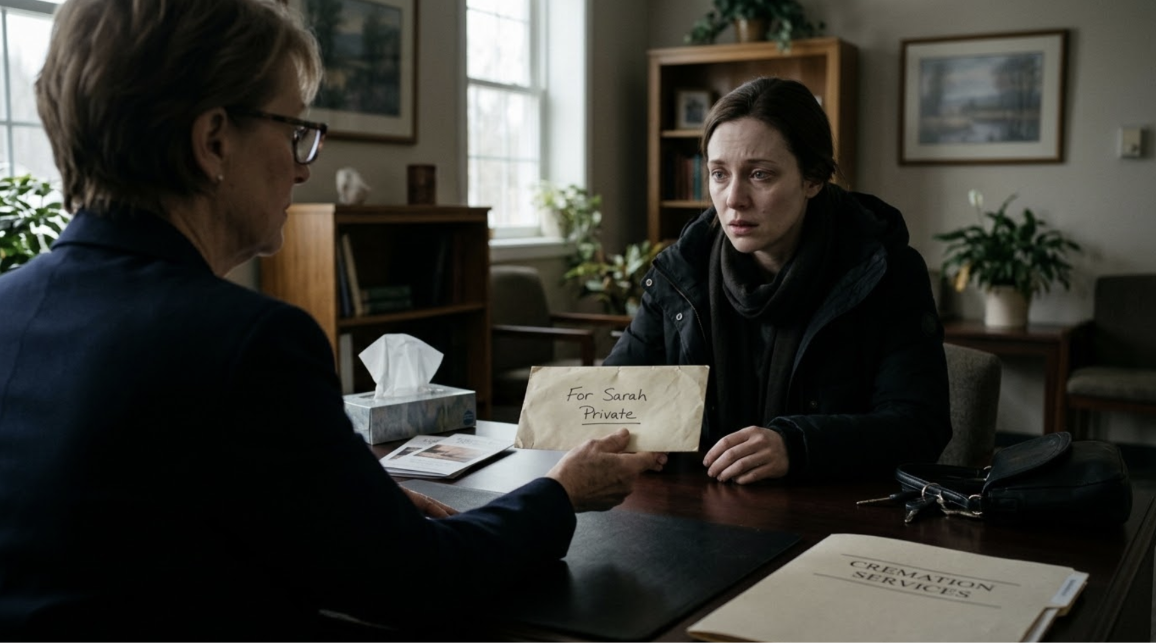
A man named Pete met me.
He spoke gently and brought me into his office.
There was a clock on the wall.
A desk covered with neatly arranged documents.
A filing cabinet near the door.
Nothing about the room seemed unusual.
Then Pete placed a folder in front of me.
He explained that something had been found during the inspection of Dad’s belongings.
An envelope.
My name was written across it.
Janet.
I recognized the handwriting before I even touched the paper.
Dad always formed certain letters the same way.
The careful strokes.
The slight pressure of his pen.
The way his handwriting became firmer whenever he considered something important.
My throat tightened.
“Where did you find this?”
Pete explained that Dad had been wearing his jacket when he arrived at the facility.
The staff had followed their normal procedure for documenting personal belongings.
That was when the envelope was discovered.
I looked at him.
“Did Ray know it was there?”
Pete checked what he had.
“There isn’t anything showing that your brother knew about it.”
I stared at the envelope.
Dad had hidden something in his own clothing.
Something addressed specifically to me.
I couldn’t understand why.
I asked Pete whether he knew anything else.
He considered the question.
Then he told me Dad had seemed unusually concerned about keeping his jacket with him.
That detail stayed with me.
Dad had always cared about his belongings.
But this sounded different.
This sounded deliberate.
I looked at the folder again.
Inside was a letter.
There was also an official-looking document.
And another smaller envelope.
The smaller one had Ray’s name written on it.
For a moment, I couldn’t bring myself to touch anything.
My hands were shaking.
Pete didn’t rush me.
He simply waited.
I took the letter out first.
The paper was folded carefully.
The date at the top was November 3rd.
I stared at it.
Dad had written this before he died.
Before Ray called me.
Before the cremation.
Before anyone told me there was nothing left to discuss.
I unfolded the first page.
He had addressed it to me with the tenderness he rarely expressed aloud.
Then came an apology.
Not a vague apology.
Not something written out of politeness.
Dad was telling me that he had kept something important from me while he was alive.
I stopped reading.
My eyes filled immediately.
Dad had apologized to me before.
But almost never in writing.
He had always preferred to fix whatever was wrong rather than explain his feelings.
Seeing him admit that he had failed to tell me something frightened me more than I expected.
I looked toward Pete.
He gave me a little privacy by turning his attention to the paperwork on his desk.
I wiped my face.
Then I returned to the letter.
Dad explained that Ray had taken him to the bank.
Ray had offered to help organize his accounts.
Dad had agreed.
He was getting older.
And he trusted his son.
I knew that much.
Ray had been handling errands and appointments for years.
Helping Dad with financial paperwork would not have seemed unusual.
But Dad described something that had happened inside the bank.
The manager had asked whether he understood that certain accounts were being placed under Ray’s control.
Dad had been surprised.
He hadn’t agreed to give his son that authority.
When he said so, Ray became angry.
I read the paragraph again.
Then again.
I could almost hear Ray’s voice.
He had a particular way of speaking when someone challenged him.
His words became sharper.
His patience disappeared.
He acted as though disagreement were a personal insult.
According to Dad, Ray had told the bank manager that our father was becoming forgetful.
That he sometimes misunderstood things.
That he was confused.
I covered my mouth.
Dad had been stubborn.
He occasionally forgot where he had placed his reading glasses.
But he was not a man who casually surrendered control of his accounts.
His mind had remained sharp enough to question bills and remember details from decades earlier.
He knew what he owned.
He knew what he was signing.
And he knew when somebody was trying to make decisions for him.
Dad wrote that Ray had presented papers as routine bank documents.
When Dad refused to sign, Ray accused him of making life harder for everyone.
I could imagine the scene.
Dad sitting in a bank office.
Ray beside him.
A manager waiting for an explanation.
My father realizing that the person he had trusted to help him was trying to take control of his money.
Then I reached the part that made me put the paper down.
Ray had told Dad that I would never find out what was happening.
Because I lived too far away.
I stared at the sentence.
Six hours.
That was all the distance between my father and me.
Six hours of highway.
Six hours that Ray had apparently decided made me irrelevant.
I thought about every Sunday call.
Every birthday card.
Every time I had asked whether Dad needed anything.
I thought about the money I had sent.
And I wondered how many conversations my brother had kept from me.
Dad wrote that he had challenged Ray about bringing up my distance.
Ray had claimed that I already had my own life.
That I didn’t need to be involved in family finances.
Dad disagreed.
He told Ray that I was still his daughter.
I pressed the paper against my lap.
For years, I had carried guilt about living so far away.
I had wondered whether Dad felt abandoned.
Whether Ray resented me for not being there more often.
Whether I had failed some unspoken test of being a good daughter.
Now I was reading proof that Dad had defended me when I wasn’t even in the room.
That hurt in a different way.
Because I had never known he needed to defend me at all.
I kept reading.
Dad said he had returned to the bank two days later.
This time, he went without Ray.
He spoke directly with the manager.
Together, they corrected the paperwork that had caused the dispute.
Then he did something I hadn’t expected.
He met with a lawyer.
I sat straighter.
Dad had hired an attorney.
Without telling Ray.
Without telling me.
He had taken steps to protect himself.
And he had hidden the evidence in a letter that eventually reached me through a crematorium.
I glanced toward the official document inside the folder.
The paper had a seal.
A signature.
Several lines of formal language.
I reached for it carefully.
At the top was a title that made my heart pound.
Last Will and Testament of William Morrow.
My father’s full name.
The very document Ray had insisted did not exist.
I looked at the signature.
Then the witnesses.
Then the date.
November 6th.
Three days after the bank incident.
My father had written a new will.
And my brother had lied to me.
I sat in Pete’s office, staring at the proof.
Everything Ray had told me since Dad’s death suddenly felt uncertain.
The cremation.
The missing paperwork.
The empty house.
The way he had rushed me away from asking questions.
I had come to collect one forgotten item.
Instead, I was holding the first evidence that my brother had been keeping far more from me than I ever imagined.
I looked down at Dad’s letter.
There were still several pages left.
I turned to the next one.

